

- Severity: CVSS 10.0 (Critical)
- Affected: Veeam ONE 13.0.2.6723 and earlier version 13 builds
- Patched: Veeam ONE 13.1.0.7034 · Exploitation: No known active exploitation
Introduction
CVE-2026-64633 is a maximum-severity remote code execution vulnerability affecting the agent host in Veeam ONE. Veeam published its security advisory on August 4, 2026, after releasing the fixed Veeam ONE 13.1.0.7034 build on July 29.
The vulnerability is classified as CWE-94: Improper Control of Generation of Code, commonly called code injection. Its CVSS v4.0 vector confirms that exploitation is possible over the network, requires low attack complexity, needs no privileges, and requires no user interaction.
The public advisory is limited to Veeam ONE version 13. Veeam has not published a separate statement declaring older major versions or particular deployment configurations unaffected. Other Veeam products are outside this CVE’s published scope, and Veeam ONE 13.1.0.7034 is the first confirmed fixed build.
Attribution note: Veeam says the vulnerability was reported through HackerOne. Neither the vendor advisory nor the CVE record publicly names the individual researcher or links to a detailed researcher write-up.
This is bad and you should patch now. A network-reachable monitoring agent that accepts unauthenticated code injection is not the kind of observability most defenders had in mind.
What Happened
Veeam’s public description is unusually brief: CVE-2026-64633 allows remote, unauthenticated code execution on the Veeam ONE agent host. The CVE record maps the weakness to CWE-94, meaning attacker-controlled input can reach a code-generation or execution path without adequate control.
A successful attacker can therefore make the affected agent host execute code without first obtaining a Veeam account, local credentials, or help from a user. The vendor has not disclosed the vulnerable endpoint, protocol message, parsing function, payload structure, resulting process identity, or privilege level.
No public proof of concept was identified during our research. CISA’s SSVC record marked exploitation as none on August 4, while rating the vulnerability as automatable with total technical impact. That can change quickly once researchers and attackers compare the vulnerable and patched builds.
No login prompt, no malicious attachment and no “please click Enable Content.” The agent host merely needs to expose the vulnerable path to the attacker. :/
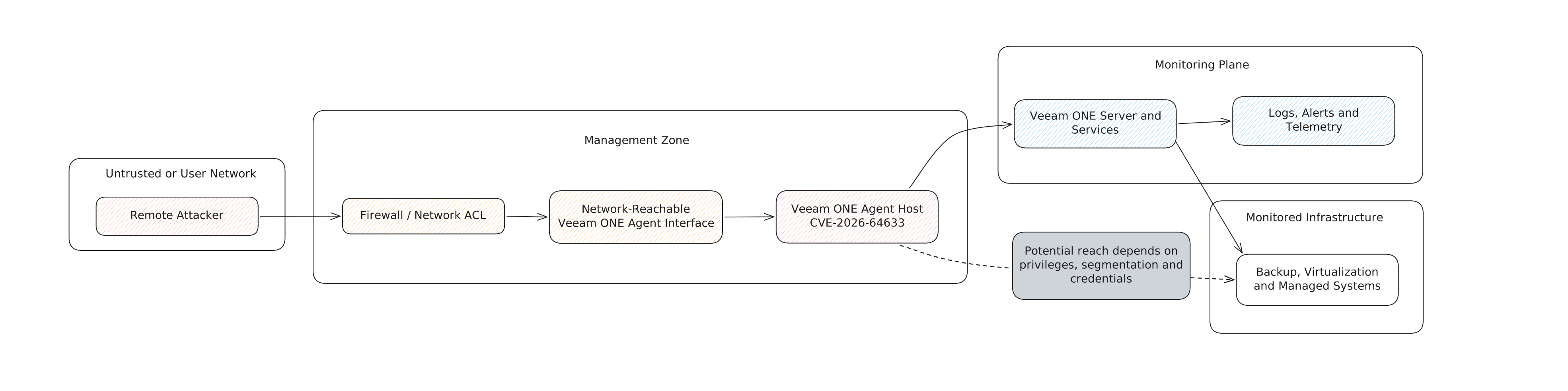
Fig 1: Veeam ONE Agent Trust Boundary and Potential Blast Radius
Attack Sequence
At the level currently confirmed, an attacker first identifies a network-reachable Veeam ONE agent host running an affected version. The CVSS vector indicates that the attack does not depend on an existing account, elevated permissions or user interaction.
The attacker then sends crafted network input to the exposed agent functionality. Because the vulnerable code path does not properly control code generation, that input reaches an execution sink and causes attacker-controlled code to run on the agent host.
From there, the attacker has a foothold inside the management or monitoring environment. What happens next depends on the agent host’s privileges, network placement, stored material and access to monitored infrastructure. Veeam has not published enough technical detail to claim a specific lateral-movement route, so defenders should treat broader compromise as possible rather than guaranteed.
The attacker does not need a key to the building. The vulnerable service just has to answer the door.
Why This Is Especially Dangerous
Veeam ONE is designed to communicate with backup, virtualization and other infrastructure components. Veeam’s documented architecture includes connections to Veeam Backup & Replication, Backup Enterprise Manager, hypervisors, databases and monitored guest systems. A compromised host in that part of the network can be far more useful than a compromised employee workstation.
Depending on the deployment, an attacker may be able to:
- Execute arbitrary code on the Veeam ONE agent host.
- Establish persistence using services, scheduled tasks or startup locations.
- Access configuration, telemetry or credentials available to the compromised process.
- Tamper with monitoring services or logs to reduce defender visibility.
- Probe systems reachable from the agent host.
- Use the host as a staging point for lateral movement.
- Disrupt monitoring during a wider intrusion or ransomware operation.
The highest-risk deployments are those where agent-facing services are exposed to the internet, reachable from user networks, placed inside flat management networks or operated with unnecessarily privileged service accounts.
Monitoring infrastructure is supposed to watch the fire. It should not become the ignition source.
Affected Versions
| Branch | Vulnerable Versions | Fix Available |
|---|---|---|
| Veeam ONE 13 | 13.0.2.6723 and all earlier version 13 builds | Yes, upgrade to 13.1.0.7034 |
Veeam released build 13.1.0.7034 on July 29, 2026. The vendor advisory was published on August 4 and identifies that build as the version containing the security fix.
Veeam has not published a configuration-based exemption or workaround. Other Veeam products are not included in this CVE’s scope, but they may have separate advisories and should be assessed independently.
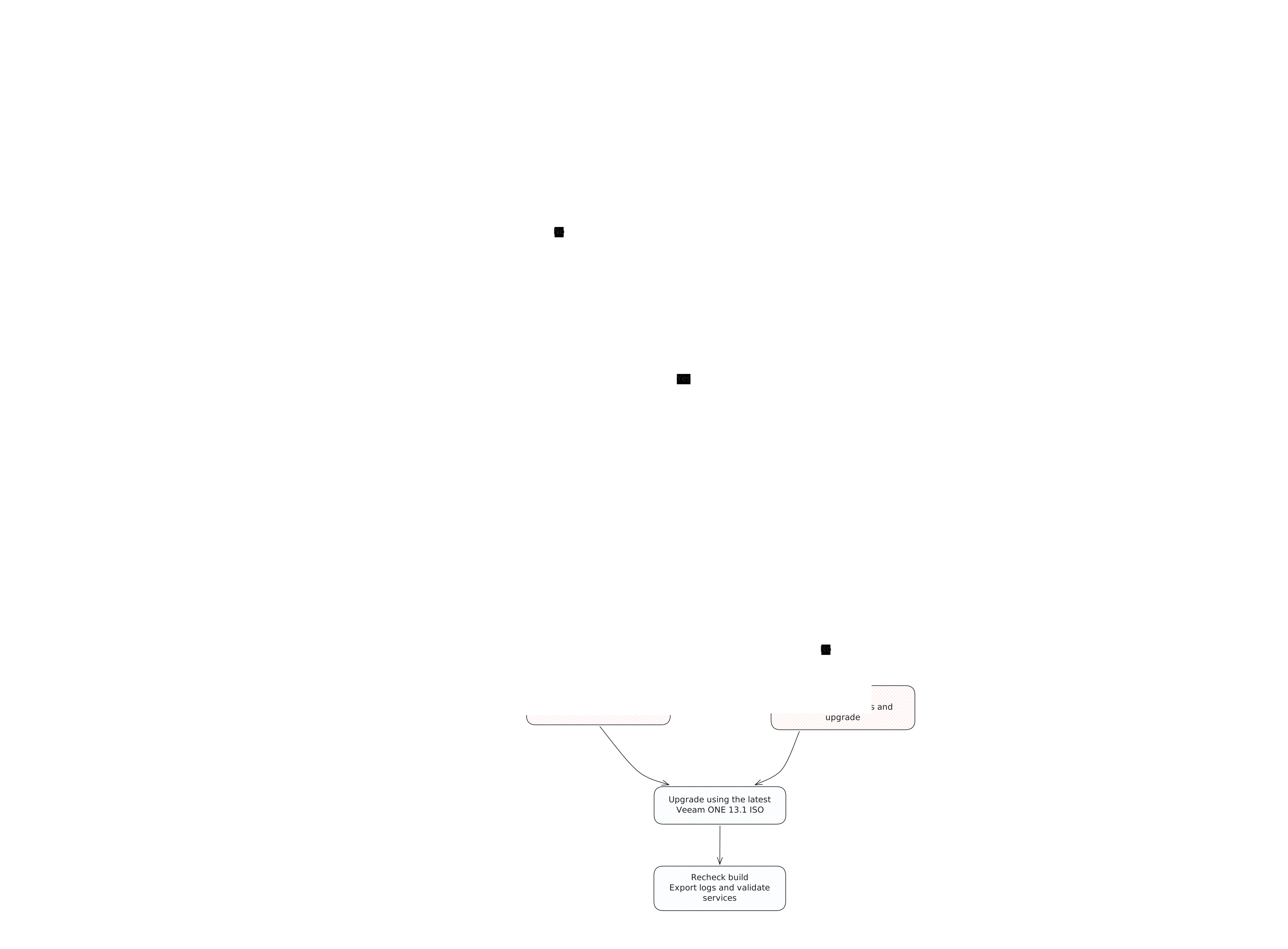
Fig 2: Version Verification and Patch-Priority Decision Tree
Mitigations
1. Upgrade to Veeam ONE 13.1.0.7034
Install Veeam ONE 13.1.0.7034 or a later supported build. Veeam provides the 13.1 ISO for upgrading existing Veeam ONE 12 and 13 deployments.
Check the installed build under:
Veeam ONE Main Menu > Help > About
Plan for a possible reboot during the upgrade and follow your normal configuration-database backup and change-control procedures.
2. Restrict network access until the upgrade is complete
Allow agent and management communication only from explicitly required systems. Remove internet exposure and block access from user, guest, wireless and other untrusted network segments.
Veeam documents TCP 2805 as the default Veeam ONE agent communication port, alongside several other ports used by the platform. However, Veeam has not identified the exact vulnerable listener, so do not assume filtering TCP 2805 alone is a complete workaround.
3. Preserve and review logs before making major changes
Export Veeam ONE logs before upgrading or rebuilding suspicious systems. Use the Veeam ONE Settings Utility:
C:\Program Files\Common Files\Veeam\Veeam ONE Settings\VeeamOneSettings.exe
Select Export Logs from the lower-left corner.
Veeam ONE 13 application logs are also stored under:
%ProgramData%\Veeam\Veeam ONE\Logs\
Agent-related logs may be available under:
%ProgramData%\Veeam\Veeam ONE\Logs\Agent\
4. Review the host’s trust and privilege boundaries
After patching, confirm that the Veeam ONE host is isolated within a dedicated management segment. Limit outbound connectivity, review local administrator membership, rotate credentials exposed to the host and ensure service accounts hold only the permissions required for monitoring.
5. Do not rely on an unofficial workaround
Veeam has not published a workaround for CVE-2026-64633. Network restrictions can reduce exposure, but upgrading to the fixed build is the required remediation.
Indicators of Compromise
As of August 6, 2026, Veeam has not published exploit-specific IP addresses, domains, file hashes, payload names or other indicators for CVE-2026-64633. No public proof of concept was identified during our research, and CISA’s available SSVC data recorded no known exploitation on August 4.
Until technical indicators become available, defenders should hunt for behavioural evidence.
On the agent host
- Unexpected child processes launched by Veeam ONE agent or monitoring components.
- New services, scheduled tasks, startup entries or local administrator accounts.
- Recently created executables, scripts or archives in temporary and application directories.
- Unexplained crashes or restarts of Veeam ONE services.
- Changes to service executable paths or service-account assignments.
- Suspicious outbound connections initiated shortly after inbound agent traffic.
In traffic logs
- Agent-service connections originating from internet addresses or user networks.
- Scanning or repeated connection attempts against Veeam ONE hosts.
- New outbound connections from an agent host to unfamiliar external destinations.
- Unexpected access from the agent host to administrative services on internal systems.
- Large or unusual payloads sent to management interfaces.
Configuration integrity
- Modified Veeam ONE binaries, configuration files or firewall rules.
- Newly permitted inbound ports or widened network ACLs.
- Changes to endpoint-security exclusions.
- Disabled logging, monitoring or endpoint-protection services.
- Credentials or service accounts used from previously unseen systems.
Preserve logs before remediation where compromise is suspected, and monitor Veeam’s advisory for technical updates or newly published indicators.
References
- Veeam KB4892: Vulnerabilities Resolved in Veeam ONE 13.1
- Veeam KB4762: Release Information for Veeam ONE 13 and Updates
- Veeam KB4858: Security Fixes and Improvements in Veeam ONE
- NVD: CVE-2026-64633
- CVE Program: CVE-2026-64633
- Secure ISS: Veeam Critical Vulnerabilities
- Veeam KB1862: How to Collect Logs for Veeam ONE
- Veeam ONE 13 Port Requirements
- MITRE CWE-94: Improper Control of Generation of Code